
Isle of Skye: A Wee Local Guide from Jim at Scotland’s Wild
I’m Jim from Scotland’s Wild, and in my job I feel like I’m never away from the Isle of Skye.
So what is it that keeps me — and my guests — going back there? What makes around 650,000 people visit this place every year?
Simple: Skye’s got something for everyone. Whether you’re into photography, landscapes, history, whisky, or myths and legends… Skye delivers.
Don’t believe me? Let me try to convince you with this wee guide to the Isle of Skye. (Click the picture below to watch the video on YouTube).
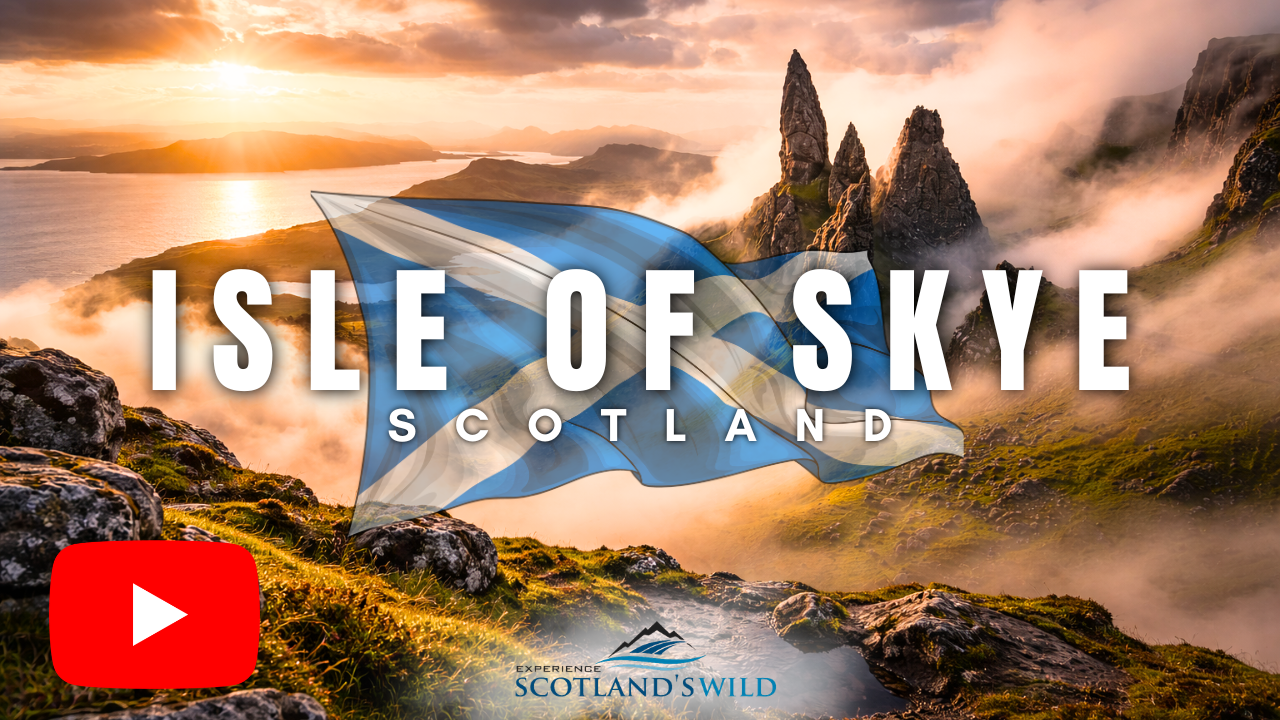
Where is Skye, and how do you get there?
Skye sits off the north-west coast of Scotland, and at 639 square miles, it’s the largest of the Inner Hebrides. Around 13,000 people call it home, and tourism dominates island life — especially in the high season.
Since 1995, visitors can access the island via the Skye Bridge at Kyle of Lochalsh.
There are also two ferries still operating to Skye:
The Caledonian MacBrayne (CalMac) service from Mallaig to Armadale
The small turntable ferry from Glenelg to Kylerhea
I always think of Skye as being shaped like a hand, with the “fingers” being the peninsulas that jut out from the “palm” into the sea — places like Sleat, Trotternish, Waternish, Minginish, and Duirinish. Even the names make me want to explore.
So… what are we waiting for? Let’s go.
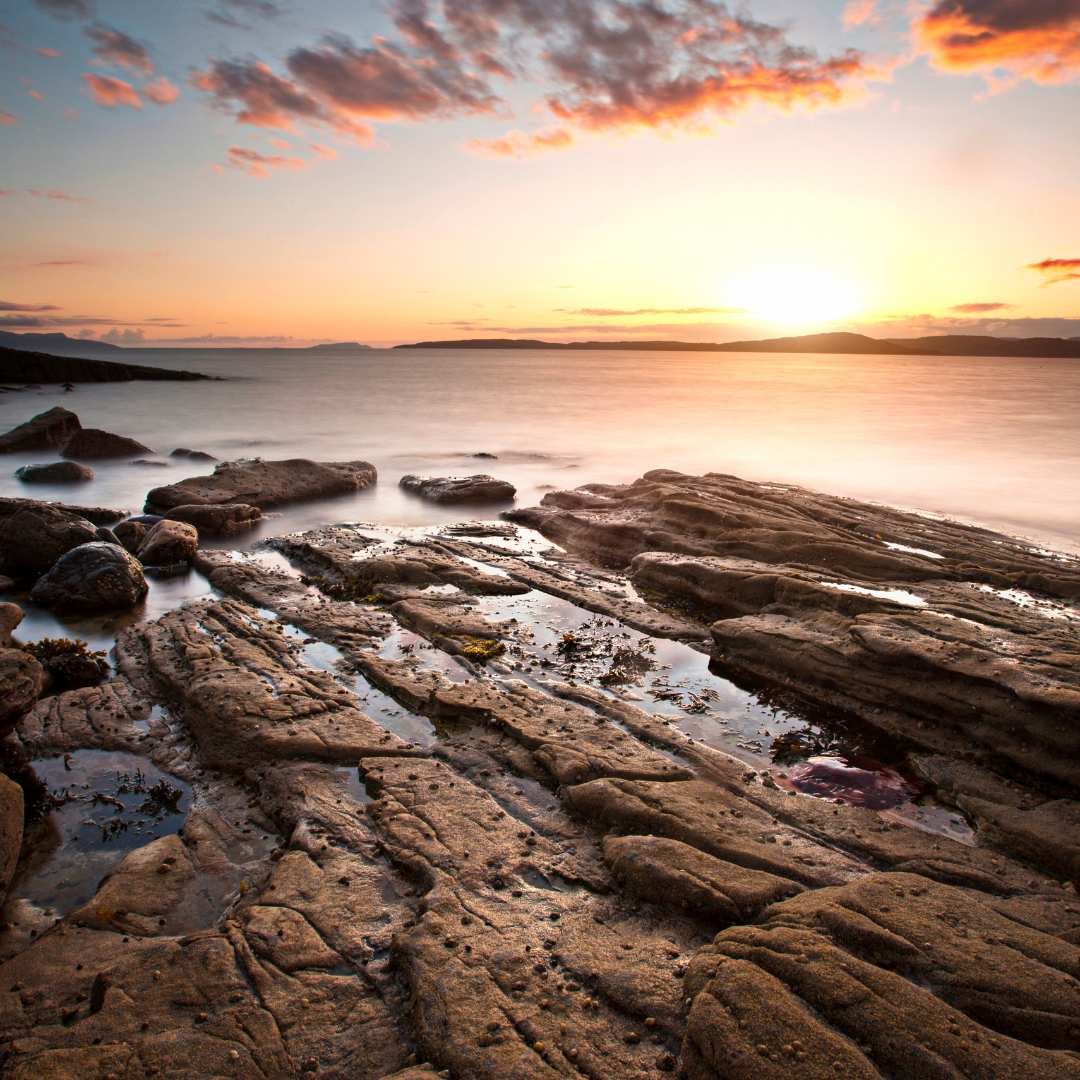
For the history buffs
If you love history, Skye has it all — and we can start way back.
Skye in the age of dinosaurs
Let’s time-travel to the Jurassic Period, roughly 168 million years ago, when dinosaurs walked the Earth. It’s hard to picture it now, but Skye was once a subtropical land of dense forests, lagoons, and rumbling volcanoes.
The island has dinosaur footprint and fossil sites that are hugely important for palaeontology. A must-see is the dinosaur footprints at An Corran Beach (Staffin) — but you’ll need to visit at low tide to spot them. Many of Skye’s dinosaur finds can also be explored at the Staffin Dinosaur Museum.
From early people to clans and castles
Skye has been inhabited by hunter-gatherer humans since the earliest times, and over the centuries it’s been shaped by different cultures — including the Picts, the Gaels, and Viking (Norse) invaders.
The Pictish tribes occupied parts of the Highlands during the Iron Age (roughly 700 BC to 400 AD) — a time of forts, farmsteads, and iron smelting.
One of the lasting legacies of that world is the broch — a kind of roundhouse/fort. A great example is Dun Beag Broch on Skye, which gives you a real feel for Iron Age island life.Next came the Gaels, travelling from Ireland to Scotland’s west coast around 500 AD. They brought Christianity, the Gaelic language, and culture, shaping the region for centuries.
Then the Vikings arrived around 800 AD, settling and holding sway over Skye for roughly 450 years. Skye and other islands were effectively run as autonomous Kingdoms of Norway until 1266, when Scottish control returned.
Out of that Norse–Gaelic mix came two of the most powerful clan names on Skye: the MacDonalds and the MacLeods — and there’s plenty for history lovers to get their teeth into.

Dunvegan & Duntulm: power, rivalry, and a ghost story
Dunvegan Castle is the seat of Clan MacLeod, and has been since the 13th century. It’s famously the oldest continuously inhabited castle in Scotland, in a gorgeous lochside setting absolutely steeped in history.
You can also see echoes of clan rivalry at the now-ruined Duntulm Castle on the edge of the Trotternish Peninsula. It changed hands over the centuries, and local legend says it was abandoned in the 1730s after the infant son of the clan chief fell from a window to his death on the rocks below. The nursemaid blamed for it was, the story goes, drowned in Palm Bay — and her ghost is said to haunt the castle still.
The War of the One-Eyed Woman
Ever heard of the War of the One-Eyed Woman?
This conflict between the MacLeods and MacDonalds took place in the late 15th century. In an attempt at peace, the MacLeod chief offered his sister Margaret in a handfast marriage to Donald MacDonald — with the condition that if they produced a male heir within a year and a day, the marriage would become permanent.
No child came from the union, and Margaret was returned — but in a way meant as a brutal insult. She had lost sight in one eye, and was sent back tied up and facing backwards, on a one-eyed horse, led by a one-eyed servant, followed by a one-eyed dog.
As you can imagine, the peace didn’t last.
The feud culminated in the Battle of Coire na Creiche (1601) in Glen Brittle — very close to where the Fairy Pools are today, beneath the Cuillin. The bloodshed was so bad that Scotland’s Privy Council was forced to intervene and end the feud.

Bonnie Prince Charlie, Flora MacDonald, and the Skye Boat Song
You might recognise the famous Skye Boat Song — I won’t subject you to my singing again (my dog Jasper already hid behind the couch).
The song tells the story of Bonnie Prince Charlie’s escape after the defeat at Culloden (1746). It recounts how Flora MacDonald helped him evade government troops by disguising him as a serving maid and travelling across the water from Benbecula to Skye.
Flora later settled on Skye and is buried at Kilmuir Cemetery on the Trotternish Peninsula. It’s said her funeral was attended by 3,000 mourners, and fittingly, her grave looks out towards the islands of her birth.
If you love stories like this, you’ll get a lot more out of Skye with a guide who can bring the places — and the people — properly to life. Our Skye tours are built around exactly that.
For lovers of myths and legends
Scotland’s loaded with fairy tales and legends — and Skye is an island packed with them.
Strictly speaking, Gaelic speakers might refer to fairies as the sìth (or the fairy folk), while in Scots you’ll often hear the guid folk or the wee folk.
Here are a few tales I love.

The magical waters of Sligachan
The waters under the old bridge at Sligachan are said to be a portal to the world of the wee folk — and if you’re brave enough, they’ll grant you eternal beauty.
The story goes back to a warrior queen called Scáthach, challenged in battle by Cú Chulainn, the Irish demigod warrior. The fighting dragged on for days. Scáthach’s daughter, terrified for her mother, begged the fairies for help — and was told to wash her face in the river to gain the wisdom to end the conflict.
With that knowledge, she created a great feast. The smell of food reached the warriors, a truce was called, and after breaking bread together, tradition demanded the fight could not continue. An honourable draw was declared.
And the tears shed in the river that day? They left magic behind.
It’s said if you submerge your face in the waters for seven seconds, eternal beauty will be bestowed upon you — but you must let your face dry naturally, or the magic won’t work.
Trust me, I’ve dipped my face in there hundreds of times. I’m actually 147 years old… but I know I don’t look it.
The Fairy Glen
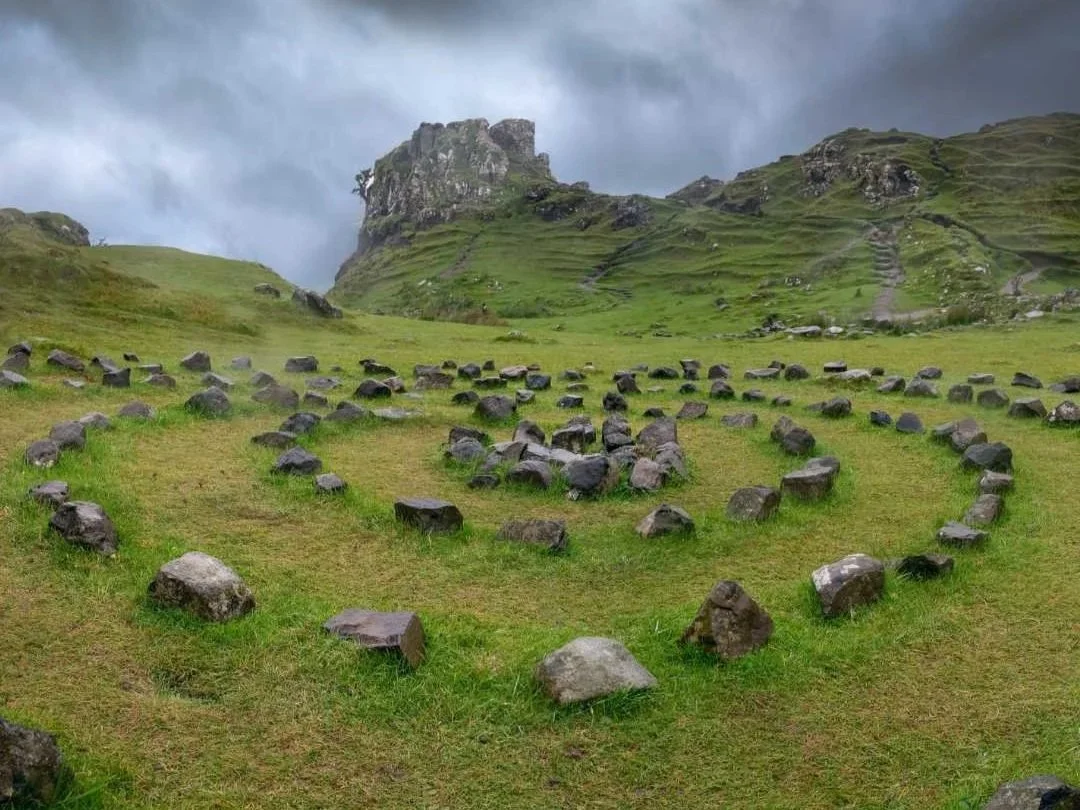
If you want somewhere that genuinely feels like another world, visit the Fairy Glen. The strange little mounds and rocky outcrops are said to be gateways to the fairy netherworld — there’s even what locals call a “fairy castle”.
Experts will tell you it’s likely the result of a post-glacial landslide from long ago… but I’m an old romantic. Whether it was fairies or glaciers, it’s like walking into the Shire. It’s properly magical.

The Old Man of Storr
The Old Man of Storr is probably Skye’s number one attraction — and it’s loaded with legend.
My favourite story is of an ancient giant who protected these lands for generations. He refused to convert to Christianity and was turned to stone. When he was buried, his thumb remained above ground — and that’s the towering pinnacle we see today.
The brain boxes will tell you it’s the remains of an ancient volcanic plug… but I’m sticking with the big stone guy with the big thumb.
Whatever you believe, the walk up is simply brilliant — and the views across to the mainland are worth every step.
Want to visit these spots without worrying about routes, parking, or what you’re actually looking at? That’s exactly where a guided Skye day makes the difference.
For photographers and landscape lovers
We all love snapping away with our cameras on holiday — and trust me, Skye will not disappoint. If you love landscape photography, you’ll find inspiring views at just about every turn.

The Cuillin Mountains
There’s no more dramatic landscape than the imposing Cuillin Mountains. These jagged peaks reach into the sky, practically begging to be photographed.
Formed from ancient magma chambers and sculpted by glaciers, the Cuillin draw mountaineers from around the world — and they’re widely regarded as some of the UK’s most technically challenging peaks. They require scrambling skills and proper equipment, so they’re not for the faint-hearted.
For cracking viewpoints and photos, you can’t go wrong at:
Sligachan Bridge
The Fairy Pools
Glen Brittle
Trotternish: the “greatest hits” peninsula
A must-see on Skye is the Trotternish Peninsula, with its dramatic escarpment and iconic landmarks.
It’s where you’ll find:
The Old Man of Storr
The Quiraing, a landscape of pinnacles, ramparts, and hidden hollows that can keep adventurous photographers busy for hours.
The Old Man is more accessible via a well-marked path — and you can walk up to the famous photographer’s viewpoint for that classic look back at the pinnacle with Skye spread out below.

Kilt Rock, Mealt Falls, and Lealt Falls
Two waterfalls are absolutely worth your time:
Mealt Falls at Kilt Rock — where the waterfall drops dramatically towards the sea, beside towering basalt columns said to resemble the pleats of a kilt.
Lealt Falls — dropping down a tree-lined gorge into the bay below.
At Lealt, a path down to the shore also reveals remains of Skye’s industrial past — including an old salmon fishing bothy and an old diatomite processing site.
That place has a wee soft spot in my heart. In the 1800s, diatomite was mined and processed on Skye, then shipped by puffer boats to Ardeer in south-west Scotland, where it was mixed with nitroglycerine to make dynamite. I was born and brought up in that dynamite town — and plenty of my ancestors worked in the factory. So Lealt feels like a wee connection I didn’t even know I had… until I did.
For whisky lovers
Ah, the water of life. The amber nectar. A wee dram. Liquid gold.
Did you really think I could do a Skye guide without mentioning Scotland’s national drink?
Like many parts of the Highlands, people on Skye had been distilling and smuggling whisky since at least the 15th century — the remoteness of the rugged Highlands and islands meant less interference from excisemen. After 1823, legal distilling was sanctioned and illicit stills rapidly declined.
Today, Skye has two distilleries:
Talisker (Carbost)
The biggest is Talisker, founded in 1830 in the village of Carbost. It uses mineral-rich water from a spring that flows down through the site.
I’d recommend a visit for tours and tastings — they make a fine range of single malts. My personal favourite is Talisker Port Ruighe, finished in port casks for a sweeter, fruitier note.
Torabhaig
For many years, Talisker was the only distillery on Skye — but that changed in the 2010s, when Torabhaig opened in the south of the island. Based on an old farmstead built using stones from a former castle on the site, it focuses on peatier styles and has a cracking wee café tucked into its courtyard.
Whether you prefer Talisker’s maritime character or Torabhaig’s smoky notes… all I can say is: slàinte.
Scotland itineraries that include Skye (3-day / 5-day / 7-day)
One of the great things about Skye is how easily it fits into a wider Scotland trip. It links to the mainland by bridge or ferry, and it also connects nicely to the Outer Hebrides via the ferry from Uig to Tarbert (Harris) or Lochmaddy (North Uist).
Here are three of our Scotland’s Wild tours that incorporate Skye.

This is our best-selling Skye tour — and it’s easy to see why.
Day 1: Edinburgh → up the west coast via Loch Lomond, Glencoe, and the Glenfinnan Viaduct → over the bridge to Skye
Day 2: Full day exploring Skye’s iconic sites
Day 3: Return towards Edinburgh via Eilean Donan Castle, Fort Augustus & Loch Ness, through Cairngorms National Park, stopping in Pitlochry, then back to Edinburgh
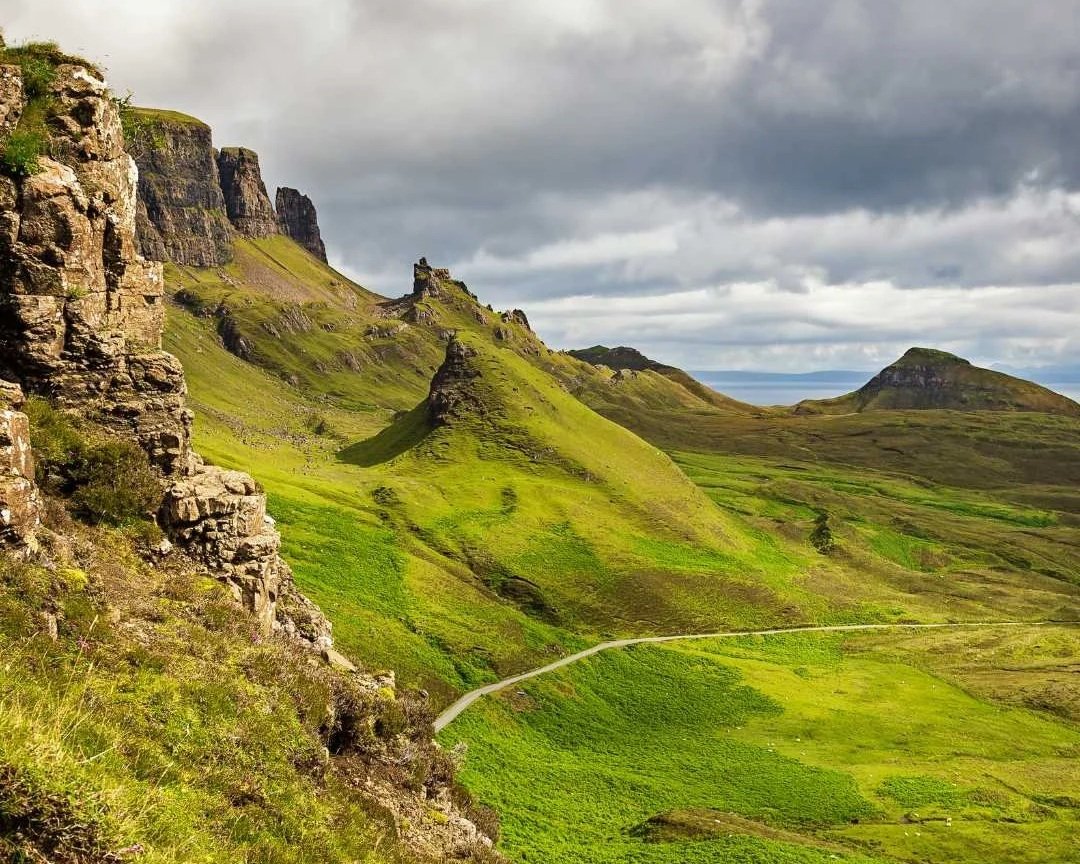
A longer route that lets us take in more of the west coast and Highland highlights.
You’ll get time in places like Argyll, Inveraray, and an overnight in Oban, before heading to Skye via Glencoe and Glenfinnan. After your Skye adventure day, we head back via Eilean Donan, stop at Urquhart Castle on Loch Ness, overnight in Inverness, then finish with Culloden Battlefield, a run through the Cairngorms, and a whisky experience at Dalwhinnie Distillery, before dropping you back in Edinburgh.
This is the monster — the full Highland-and-islands adventure.
Alongside Skye and the big mainland classics — Glencoe, Glenfinnan, Eilean Donan, Loch Ness, Inverness, the Cairngorms, and Pitlochry — you also get the added magic of the Outer Hebrides, with two nights in Stornoway to explore the wild islands of Lewis and Harris.
For full details of each Skye itinerary, head to our Skye tours on the Scotland’s Wild website and choose the one that fits your trip best.
Why Skye keeps pulling us back
Whatever Skye tour you choose, I can guarantee it’ll be full of:
history, landscapes, whisky, myths, castles, and mountains.
Add in plenty of laughs, good music (our van playlists are legendary), and that wee bit of Highland magic in the air… and you’ve got the kind of trip people talk about for years.
Hopefully, I’ll see you on tour soon.